When selecting acoustic foam ceiling tiles, aim for higher noise absorption, easy installation, and durability for your space. This guide features five top options suited for home studios, offices, bedrooms, and entertainment areas. Best for beginners: self-adhesive panels that require minimal prep. Best for sound-heavy rooms: high-density foams with proven noise reduction coefficients. Best for decorative ceilings: groove or wedge designs that double as art.
| Product | Key Benefit | Best For |
|---|---|---|
| Soundsbay 18 Pack (12″ x 12″ x 0.4″) | High-density polyester with self-adhesive backing | Home office and small studios |
| TroyStudio 12″ x 12″ x 3″ (12 Pcs) | Thick, high-density foam with groove design | Medium-to-large rooms needing strong reverberation control |
| Soundsbay 12 Pack (12″ x 12″ x 0.4″) | Excellent NRC and versatile use on walls/ceilings | Recording spaces and home theaters |
| TroyStudio 12″ x 12″ x 2″ (52 Pcs) | Broad coverage with groove texture | Large rooms or ceilings needing substantial absorption |
| GUERRI 36 Pack (12″ x 12″ x 2″) | Wedge/triangle design for aesthetics and acoustics | Creative studios and decorative ceilings |
Soundsbay Acoustic Panels 18 Pack

These self-adhesive foam panels are designed with high-density polyester fiber and a porous structure to reduce sound reflections. They work well for home offices, small studios, and media rooms. The self-adhesive backing simplifies installation without extra glue or tape, and you can apply them as a full wall or ceiling treatment for stronger noise reduction. Best for: quick upgrades to rooms with lightweight noise issues.
Best for: buyers seeking ready-to-use ceiling or wall panels that don’t require tools. Better for: compact spaces where a clean, uniform look matters. Choose this if: you want a straightforward installation with reliable sound absorption.
Caution: Adhesive strength may vary with wall texture; ensure a clean surface for best adhesion. Consider additional mounting if applying to rough or textured ceilings.
TroyStudio Thick Acoustic Panels 12″ x 12″ x 3″ (12 Pcs)
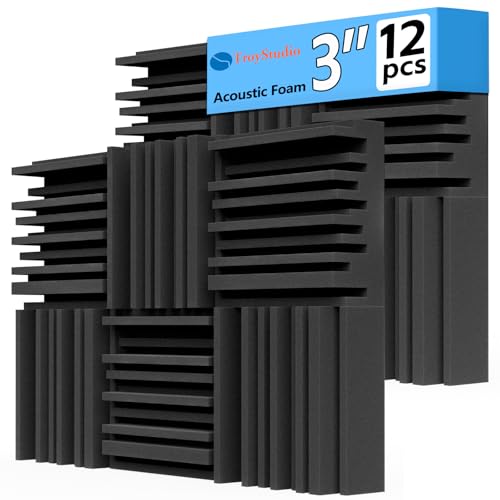
Thick, high-density polyurethane foam panels with a groove design deliver strong reverberation and noise reduction. With an NRC around 0.9, these panels are suitable for studios or rooms where clarity of sound is essential. Best for: larger spaces needing substantial absorption and an elevated interior aesthetic. Better for: walls or ceilings when you want a bold texture that also improves acoustics.
Limitation: They are heavier and may require more robust mounting solutions in high-humidity areas. Avoid if your space requires ultra-thin panels for a flat finish.
Soundsbay 12 Pack 12″ x 12″ x 0.4″ Panels

This 12-pack delivers an NRC around 0.92, making it highly effective for both walls and ceilings. The panels are designed for versatile use in studios, home theaters, and living rooms where controlling reflections is critical. Best for: flexible placement with strong noise control. Better for: spaces that require a balance between absorption and decor.
Note: While great for treatment, pockets may appear on very textured ceilings if not applied evenly. Consider a smooth surface or pre-priming.
TroyStudio Thick Acoustic Panels 12″ x 12″ x 2″ (52 Pcs)
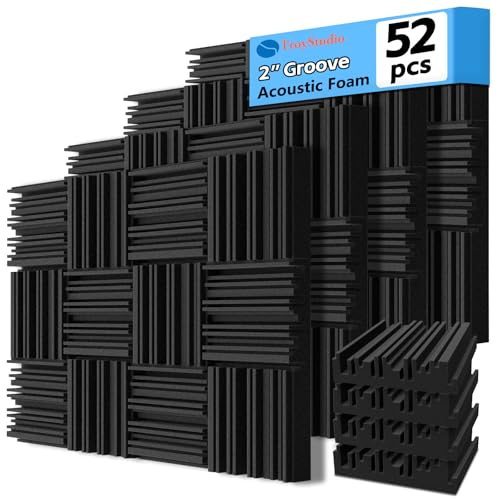
A dense 52-panel pack provides extensive coverage for large rooms. The groove design adds visual texture while contributing to acoustic performance. Best for: room-wide treatment where uniform absorption is desired. Better for: ceilings that require a cohesive look across wide areas. Choose this if: you want substantial reduction in standing waves and echo across bigger spaces.
Limitation: The large quantity may be more installation effort and inventory to manage. Ensure you have adequate wall/ceiling surface preparation before installation.
GUERRI Sound Proof Panels 36 Pack

GUERRI panels feature a wedge surface that enhances both acoustics and aesthetics. The high-density polyurethane foam is designed to absorb reflections effectively, helping to control echoes in music rooms or quiet offices. Best for: decorative studios or creative spaces where design matters as well as sound. Better for: spaces where a non-traditional, stylish surface is desired.
Limitation: Some compression in packaging means panels may take hours to days to fully regain shape. Allow full expansion before final mounting for a consistent look.
Buying Guide: Key Considerations For Acoustic Foam Ceiling Tiles
- Sound absorption vs. coverage: Higher NRC values indicate better absorption per panel. For large rooms, total coverage matters as much as panel quality.
- Panel density and thickness: Thicker or denser foams generally offer better low-frequency absorption, but may be heavier and harder to install.
- Adhesive and mounting method: Self-adhesive options simplify installation but check wall/ceiling texture compatibility. Consider complementary mounting if needed for textured surfaces.
- Design and aesthetics: Grooved, wedge, or decorative panels add visual appeal while providing acoustic benefits. Choose a design that matches your space’s style.
- Placement strategy: For best results, treat first reflection points on ceilings and walls near the primary sound source and listening position.
- Maintenance and durability: Look for flame-retardant certifications and non-toxic materials for safer indoor use.
- Expansion and fit for space: Large room applications may require multiple packs to achieve uniform coverage and avoid gaps.
FAQ
- What NRC is good for a home recording space? A typical good range is 0.8–0.92 depending on panel density and layout.
- Do I need special tools to install these panels? Self-adhesive options require minimal tools; other panels may need mounting tape or adhesive suitable for ceilings.
- Can foam panels be used on ceilings and walls? Yes, many panels are designed for both walls and ceilings, but check the product notes for ceiling suitability.
- Will panels affect fire safety? Choose panels with flame retardant properties and confirm local building codes for ceiling installations.
- How many panels are needed for a standard room? It depends on room size and desired coverage; calculate total square footage and compare with panel coverage per pack.
- Can these panels be easily removed later? Most self-adhesive panels are removable, but adhesion strength may vary by surface.