Seeking a reliable concrete sealer for a basement floor? This guide highlights top options that protect against moisture, reinforce structural concrete, and deter cracks. It targets homeowners doing DIY basement waterproofing, general contractors, and property managers looking for long-lasting sealing solutions. Below you’ll find five proven products, each with practical use cases, pros, and a caution to consider before buying. A quick comparison table is included to help pick the right fit.
| Product | Best For | Key Benefit |
|---|---|---|
| Liquid Rubber Basement and Foundation Repair Sealant | Active leaks and flexible crack filling | Permanent waterproof membrane with high elongation |
| 1 Gallon Concrete Sealer, OAIEGSD | Outdoor or indoor concrete, high humidity areas | Penetrating, water-based protection that reduces moisture ingress |
| Rust-Oleum 301239 Concrete Moisture Stop | Moisture-prone concrete floors needing coating prep | Penetrates to seal and prepare for coatings |
| Lithi-Tek 9500 Ultra Concentrate – Ghostshield | Deep waterproofing and densification | Interior chemical densifier and waterproofer |
| RadonSeal Plus Concrete Sealer | Basements and foundations with moisture concerns | Deep penetrating internal seal against moisture |
Liquid Rubber Basement and Foundation Sealant

Best for: Basements with active leaks or frequent moisture exposure. This professional-grade sealer forms a flexible waterproof membrane that seals cracks, leaks, and joints. It claims up to 900% elongation, allowing for movement without cracking. It’s suitable for self-leveling concrete applications and adapts to indoor and outdoor use. Use this when you need a durable, long-range waterproofing system rather than a simple paint layer.
Why selected: It provides a complete basement waterproofing approach beyond standard paints, with strong adhesion to multiple substrates and lasting elasticity in varying temperatures. This is favored when a high-performance, flexible seal is essential for ongoing moisture control.
Caution: The product’s strong adhesion can make removal or future remodeling challenging. Proper surface preparation is critical to avoid poor bonding on dusty or contaminated substrates.
1 Gallon Concrete Sealer, OAIEGSD

Best for: Outdoor projects like driveways, patios, and garages where a penetrating, water-based sealer is desired. It helps prevent water absorption, reduces damage from freeze-thaw cycles, and provides invisible surface protection against oil and chemical stains.
Why selected: The penetrating, VOC-conscious formula helps extend surface life without altering appearance. It is well-suited for spaces that see heavy exposure to moisture and potential spills, making it a practical choice for basements with exterior-adjacent concrete walls or entrances.
Caution: Not suitable for areas currently leaking water or for use on floors that will receive paints or coatings where a film is required. It emphasizes penetrating protection over surface-level aesthetics.
Rust-Oleum 301239 Concrete Moisture Stop Fortifying Sealer
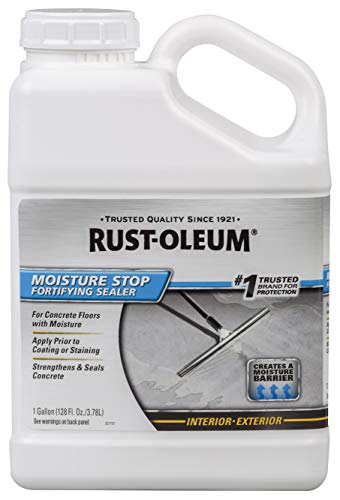
Best for: Floors needing moisture sealing prior to applying coatings. This product seals the concrete and prepares it to receive paints or sealers, with a penetration approach that respects the surface’s appearance.
Why selected: It’s a practical step before finishing coats, offering moisture control without changing the floor’s look. It’s suitable when you plan to add epoxy, paint, or sealant afterward.
Caution: It covers up to a limited area per gallon; plan for larger basements by calculating the required quantity ahead of time.
Lithi-Tek 9500 Ultra Concentrate – Ghostshield

Best for: Basements and foundations where deep penetration, densification, and moisture reduction are priorities. This concentrate is designed to densify concrete and form an internal barrier that resists moisture and vapor intrusion.
Why selected: This product combines hydrophobic protection with structural improvement by densifying the pore structure, which can reduce future moisture-related issues and improve abrasion resistance over time.
Caution: It requires proper mixing and dosing; misapplication or under-dilution can affect performance. Ensure compatibility with existing coatings or membranes if you plan to apply later.
RadonSeal Plus Concrete Sealer
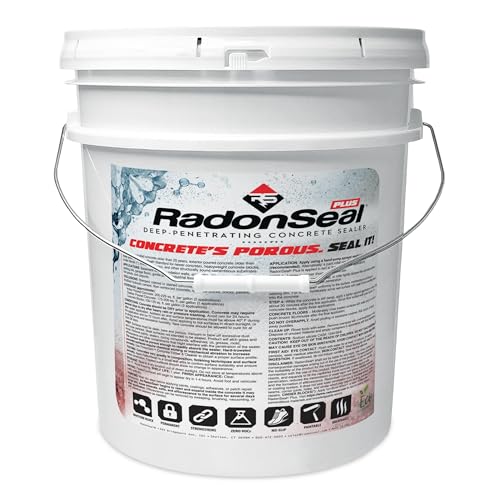
Best for: Basements and foundations where deep moisture mitigation and internal sealing are desired. It aims to reduce moisture migration and vapor transmission by reacting inside the concrete.
Why selected: RadonSeal Plus delivers a long-lasting internal seal by curing within the concrete pores rather than forming a surface film. This can help manage moisture in concrete structures that are exposed to ground moisture.
Caution: It is a penetrating product; surface appearance remains largely unchanged, which may be a consideration if you expect a visible finish or color change after sealing.
Buying Guide: Concrete Sealer For Basement Floors
What type of basement moisture am I dealing with?
- Active leaks or severe moisture? Consider a flexible, waterproofing membrane that can move with the concrete, like the Liquid Rubber option.
- Surface moisture prevention for new or relatively dry basements? Penetrating sealers (silane/siloxane) offer long-term protection without a surface film.
Penetration vs. film-forming sealers: Which should you choose?
- Penetrating sealers: Best for reducing moisture transmission and preserving the concrete’s natural look. They are ideal when you plan to finish the floor later with coatings.
- Film-forming sealers: Create a visible barrier that can be top-coated. They are useful when you want a finished look and easier cleaning.
Where will the sealer be used?
- Basement floors facing hydrostatic pressure or with soil moisture: Prioritize deep-penetrating densifiers or flexible membranes.
- Exposed exterior concrete near foundations: Look for water-based penetrating sealers or siloxane-based products that resist weathering.
Application and curing considerations
- Surface preparation: Clean, dry, and repair cracks or holes before application for best adhesion.
- Ventilation and safety: Follow label directions for ventilation and PPE, especially for solvent-based formulas.
- Re-coating intervals: Some products require curing times before applying the next coat or finish.
Compatibility with future coatings
- If you plan to paint or apply epoxy later, penetrating sealers or moisture-stop products that don’t leave a heavy film may be preferable.
- Film-forming sealers can be good if you need a uniform surface for a final decorative finish.
Quick buyer tips
- For active basement leaks, choose a flexible sealant with high elongation and durable adhesion to concrete and masonry.
- For new, dry basements, penetrating sealers help preserve the surface and extend life without altering appearance.
- Consider the area size to estimate the gallons needed; some products cover more or less area per gallon depending on porosity.
FAQ
- What is the difference between penetrating and film-forming concrete sealers?
Penetrating sealers soak into the concrete to reduce moisture transmission, while film-forming sealers create a protective outer layer. - Can I apply sealer over a painted basement floor?
Yes, but ensure the paint is fully adhered and compatible with the sealer type you choose. Some sealers require a clean, dry surface with no loose coatings. - How long does a concrete sealer take to cure?
Curing times vary by product and conditions; refer to the label for specific times and recoat windows. - Is penetrating sealant better for garages and driveways?
Penetrating sealants are commonly used for driveways and garages to prevent moisture ingress without creating a film that could peel. - Will a concrete sealer stop radon or vapor intrusion completely?
Most sealers reduce moisture and vapor transmission but do not guarantee complete radon blockage. For radon concerns, consider a dedicated radon mitigation approach. - Should I hire a pro for basement sealing?
Professional installation ensures proper preparation, application, and curing, especially for active leaks or large areas. DIY options can work for smaller projects with clear instructions.