Yes, epoxy paint projects can be tackled with a reliable spray gun designed for accurate atomization and minimal overspray. This guide highlights five epoxy-focused spray guns that balance control, durability, and value for different buyers — from DIY hobbyists to professional restorers. Each product is chosen to suit specific needs, whether you prioritize low overspray, versatile nozzle sizes, or integrated air regulation. The buyer-friendly table below helps you compare key capabilities at a glance.
| Product | Nozzle Sizes | Cup Size | Best For |
|---|---|---|---|
| ENDOZER HVLP Spray Gun Set | 1.4/1.7/2.0 mm | 20 oz (600 ml) | Professional auto finishes and primers |
| AEROPRO R500 LVLP | 1.3/1.5/1.7 mm | Standard cup (size not specified) | Low-overspray automotive work |
| 819 HVLP Kit | 1.3/1.7/2.0 mm | Standard cup | Versatile DIY to automotive coatings |
| ToCzernobgol Cordless Sprayer | 5 nozzle sizes: 1.0/1.5/2.0/2.5/3.0 mm | 500–1000 ml typical capacity | Portable DIY furniture and cabinet projects |
| GATTLELIC HVLP with Regulator | 1.4/1.7/2.0 mm | 600 cc | Automotive and household coatings with integrated regulator |
Buyer tips: choose a gun with the right nozzle sizes for epoxy, which tends to need smooth, precise atomization. A larger cup helps reduce refills for larger surfaces, while an adjustable air regulator aids in controlling spray quality. Consider whether you prefer a corded or cordless model based on your workspace and mobility needs.
ENDOZER Professional HVLP Spray Gun Set
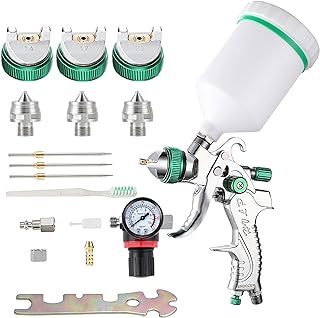
The ENDOZER set uses a gravity-feed 20 oz cup and offers three real stainless steel nozzles (1.4, 1.7, 2.0 mm) for adjustable atomization. A brass hood with 15 holes promotes uniform spray patterns, while the 1/4″ NPT inlet and quick adapter streamline connections. Fluid control adjusts paint output, and the fan pattern control determines spray width. An air-regulation valve enables precise airflow management. Best for professional auto finishes, primers, and top coats where consistent atomization matters. A potential limitation is the heavier setup for small, tight areas.
Who it’s best for: Professionals and serious hobbyists who need multiple nozzle sizes and robust control for epoxy primers and clear coats. Why selected: its stable atomization and durable materials suit demanding automotive coatings.
Limitations: Heavier weight and setup complexity may be challenging for casual DIY tasks or tight corners.
AEROPRO R500 LVLP Spray Gun

The AEROPRO R500 LVLP gun emphasizes low overspray with LVLP technology, delivering efficient material usage. It comes with three nozzle options (1.3/1.5/1.7 mm) and includes air-regulation features for precise control. The upgraded appearance adds durability. Best for automotive finishes and furniture coatings where minimizing paint waste is important. A note: LVLP systems may require careful air supply tuning to achieve consistent fan patterns, especially with thicker epoxies.
Who it’s best for: Builders and refinishing pros who prioritize material efficiency and clean finishes. Why selected: excellent paint utilization and adjustable gears reduce fatigue during longer sessions.
819 HVLP Kit

This kit provides multiple nozzle sizes (1.3/1.7/2.0 mm) for automotive paints, primers, and clear coats. The HVLP design reduces overspray and concentrates atomized paint for even coverage. It includes an air regulator and separator to help manage pressure and flow. Best for versatile DIY projects and light professional use where a flexible nozzle range matters. Limitation: like many budget HVLP kits, priming and thinner coatings may require fine-tuning for optimal results.
Who it’s best for: DIYers and light professionals needing a flexible range of coatings from primers to top coats. Why selected: adaptable nozzle trio supports varied epoxy applications without swapping tools.
ToCzernobgol Cordless Sprayer

This cordless unit uses a 1200 ml capacity with five nozzle sizes (1.0/1.5/2.0/2.5/3.0 mm) and three spray patterns. It provides mobility with two 4000 mAh batteries delivering 20–25 minutes of spraying per charge and a quick-swap design for uninterrupted work over 20–40 m². Best for portable furniture and cabinet projects where electricity access is limited. Caution: cordless operation may require frequent battery swaps for larger jobs.
Who it’s best for: Quick, portable DIY projects where power outlets are scarce. Why selected: flexibility of five nozzles and three spray patterns suits diverse epoxy applications, plus mobility.
HVLP Gun With Regulator and 10 Cups

This HVLP gun includes 1.4/1.7/2.0 mm nozzles and an integrated air regulator with a dedicated filter. The 600 cc cup and brass construction support consistent atomization for automotive paints, primers, and top coats. Best for shop setups needing a compact regulator-capable system. Limitation: the integrated regulator adds some weight and may be less suitable for very small projects requiring extreme precision in tight spaces.
Buying Guide: Key Considerations for Epoxy Spray Guns
- Nozzle options: Epoxies often require smooth atomization; choose guns with multiple nozzle sizes (1.3–2.0 mm are common) to adapt to viscosity.
- Cup capacity: Larger cups reduce refills on bigger surfaces but add weight. Match cup size to project scope.
- Air delivery: HVLP minimizes overspray; LVLP can reduce air usage but may need careful tuning for consistent film build.
- Regulation and control: An accessible air regulator and precise flow/pattern controls help dial in epoxy finishes.
- Materials and durability: Brass components and stainless steel nozzles resist chemical exposure and wear during epoxy spraying.
- Weight and ergonomics: Cordless options offer mobility but can be heavier to hold during long sessions.
Frequently Asked Questions
- What nozzle size is best for epoxy paint?
– Typically 1.3–2.0 mm nozzles provide good atomization for epoxy coatings; choose based on desired film thickness and viscosity. - Should I pick HVLP or LVLP for epoxy?
– HVLP reduces overspray and is forgiving for larger panels; LVLP uses less air and can be efficient, but may require more adjustment for consistent coverage. - Is a regulator essential on an epoxy spray gun?
– A regulator helps control pressure and flow, improving consistency and reducing runs or sags in epoxy finishes. - Do I need a cordless spray gun for epoxy work?
– Cordless models offer portability for projects without outlets but may limit battery life for large jobs. They are convenient for tight spaces. - Can I use the same spray gun for primer and clear coats?
– Yes, many guns handle primers, base coats, and clears, but verify viscosity compatibility and cleanability for each coating. - What maintenance is needed after epoxy spraying?
– Clean the nozzle, air passages, and cup promptly after use; flush with appropriate solvent to prevent curing and clogs.