High build epoxy pool paints provide durable, long-lasting protection for concrete, plaster, gunite, fiberglass, and previously painted surfaces. This guide highlights top high-build options and helps you choose the right one for your pool or aquatic project. It focuses on self-priming and two-part systems that deliver thick, smooth finishes with good chemical and abrasion resistance. The buyer who wants quick coverage, minimal prep, and a strong, stain-resistant coating will find practical picks here. The table below summarizes five strong performers and who they are best for.
| Product | Best For | Finish | Notes |
|---|---|---|---|
| Doheny’s Pro-Grade High Build Self-Priming Epoxy Pool Paint — White | New or recoat projects on concrete, fiberglass, plaster | Satin | Self-priming; good for varied pool surfaces |
| Doheny’s Pro-Grade High Build Self-Priming Epoxy Pool Paint — Blue Ice | Concrete, plaster, gunite with previous epoxy | Satin | Self-priming; versatile color option |
| Doheny’s Pro-Grade High Build Self-Priming Epoxy Pool Paint — Bikini Blue | Older or worn surfaces needing renewal | Satin | Self-priming; durable stain and chemical resistance |
| RAMUC Hi-Build Epoxy Pool Paint – Satin Finish – 2 Gallon Kit (Dawn Blue) | Concrete and plaster pools needing long-lasting protection | Satin | Two-part system; adds a level of build and smoothness |
| Olympic Pool Paint – Zeron Bikini Blue — 1 Gallon | Plaster, fiberglass, steel, aluminum pools | Two-part satin | One-coat-like application with catalyst mix guidance |
Doheny’s Pro-Grade High Build Self-Priming Epoxy Pool Paint — White

This is a self-priming, high-build epoxy suitable for concrete, fiberglass, plaster, gunite, and previously painted epoxy. The white variant offers a clean, reflective finish for sun-drenched pools. Best for first-time epoxy users seeking straightforward application on multiple surface types.
- Finish: Satin
- Surface compatibility: Concrete, fiberglass, plaster, gunite, previously painted epoxy
- Key advantage: Self-priming reduces prep steps
- Limitations: May require multiple coats for heavily pitted surfaces
Best for: Homeowners renewing a pool with mixed surface materials who want a single-coat look with dependable chemical resistance. Choose this if you prefer a self-priming formula that simplifies preparation and delivers a consistent satin finish.
Doheny’s Pro-Grade High Build Self-Priming Epoxy Pool Paint — Blue Ice

The Blue Ice variant shares the same self-priming, high-build formula and is formulated for stain, chemical, and abrasion resistance. It is well-suited for concrete, fiberglass, plaster, gunite, and previously painted epoxy surfaces, especially when color preference matters for water features or accents.
- Finish: Satin
- Surface compatibility: Concrete, fiberglass, plaster, gunite, previously painted epoxy
- Key advantage: Self-priming; color option enhances aesthetics
- Limitation: May require careful surface cleaning to prevent staining on very rough substrates
Best for: Projects where color variety aids aesthetics and where surface heterogeneity is present. Choose this if you want a color-consistent performance with strong chemical resistance and a satin sheen.
Doheny’s Pro-Grade High Build Self-Priming Epoxy Pool Paint — Bikini Blue

Bikini Blue is another color option within the same high-build, self-priming epoxy family. It targets surfaces that may benefit from a slightly warmer blue tone and a satin finish. Best for: projects that demand a premium look while preserving surface integrity and chemical resistance.
- Finish: Satin
- Surface compatibility: Concrete, fiberglass, plaster, gunite, previously painted epoxy
- Key advantage: Self-priming; color flexibility for design goals
- Limitation: Color availability may affect matching with existing pools
Best for: Pool restorations where color coordination matters or when replacing old coatings with a color that hides minor imperfections better than stark white.
RAMUC Hi-Build Epoxy Pool Paint — Dawn Blue (2 Gallon Kit)
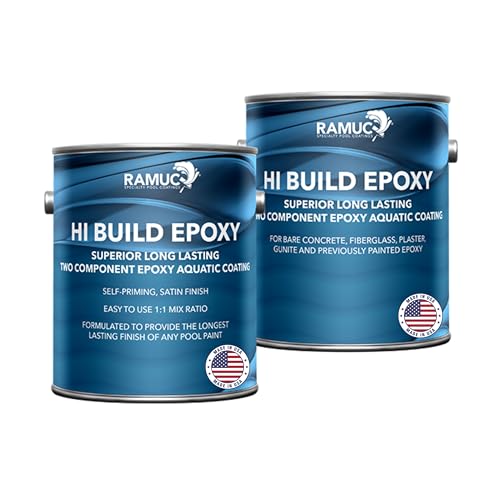
This two-part epoxy system offers a high-build, self-leveling formulation designed for smooth, long-lasting results on concrete and plaster pool surfaces. The satin finish provides a refined look while improving water resistance and surface longevity.
- Finish: Satin
- Surface compatibility: Concrete, plaster
- Key advantage: Two-part system provides robust build and durability
- Limitation: Requires correct mixing ratio and timely use to avoid premature hardening
Best for: Projects where longevity and a smooth final surface are priorities, especially on aging concrete or plaster pools needing restoration without extensive prep work.
Olympic Pool Paint — Zeron Bikini Blue

Olympic Zeron is a two-part epoxy system designed for plaster, fiberglass, steel, and aluminum pools. It aims to deliver good adhesion and durability with a color-rich finish. Best for: Surfaces that require strong bonding across multiple substrate types and a single-coat-like application with catalyst mix guidance.
- Finish: Satin (two-part)
- Surface compatibility: Plaster, fiberglass, steel, aluminum
- Key advantage: One-coat-like coverage with proper mixing
- Limitation: Mixing and timing are critical to avoid improper curing
Choose this if you want a versatile, two-part epoxy that can handle diverse pool surfaces with a consistent satin finish.
Buying Guide: Key Considerations For High Build Epoxy Pool Paint
- Surface compatibility: Verify whether the product is recommended for concrete, plaster, gunite, fiberglass, or worn epoxy coatings. Self-priming options simplify prep on mixed substrates.
- Two-part vs. single-component: Two-part epoxies generally offer greater durability and build but require precise mixing and timing. Single-component, self-priming formulas save time but may require more coats on rough surfaces.
- Finish and color: Satin finishes hide minor imperfections well and are easier to maintain. Color choices can affect heat absorption and aesthetics; lighter colors reflect heat better.
- Cure and recoat windows: Follow the manufacturer’s guidance for cure time and recoat intervals. Avoid exposure to pool use until the coating has fully cured as recommended.
- Maintenance considerations: Epoxy coatings provide chemical resistance, but pH fluctuations, chlorine levels, and pool chemistry can impact longevity. Proper surface preparation and cleaning extend life.
- Application environment: Temperature and humidity affect flow and cure. Plan applications during optimal conditions specified by the product data.
Frequently Asked Questions
- Q: Do I need a separate primer for high-build epoxy pool paints?
A: Many high-build epoxy paints are self-priming, but heavily worn or bare concrete may benefit from a dedicated primer if recommended by the product guidelines. - Q: How many coats are typically required?
A: Most high-build epoxies require 1–2 coats depending on surface condition, color goals, and the manufacturer’s instructions. - Q: Can I apply epoxy pool paint over an existing epoxy coating?
A: Some products are formulated for application over previously painted epoxy; check the label to confirm compatibility. - Q: What is the expected cure time before swimming?
A: Cure time varies by product and conditions; follow the label for safe use times after final coat dries and cures. - Q: Are these paints resistant to chemicals and stains?
A: High-build epoxy paints are designed for chemical and abrasion resistance, but ongoing pool chemistry should be balanced to maximize longevity. - Q: How do I choose the best color for my pool?
A: Lighter blues and whites reflect heat and can make water appear brighter; darker blues emphasize color depth but may heat faster. Consider pool surroundings and maintenance visibility when selecting a color.