Answering the most common questions from DIYers and contractors: choose the joint compounds and patching products that dry clearly, shrink minimally, and sand smoothly for a paint-ready finish. This guide highlights five top options and explains who each is best for. Whether you’re repairing nails, filling holes, or finishing large drywall joints, these products offer reliable results and clear indicators for when they’re ready to sand or paint.
Summary table of selected products:
| Product | Best For | Key Benefit |
|---|---|---|
| DAP DryDex Dry Time Indicator Spackling | Small interior repairs | Color change to white signals dryness |
| DAP Wallboard Joint Compound | Gypsum panel joints | Easy embedding of tape, smooth finish |
| DAP Patching Plaster | Hole and crack filling | Quick-drying, ready-to-use |
| DAP DryDex Lightweight Low Dust Joint Compound | Smooth finishes with low dust | Less shrinkage, fewer coats |
| GORILLA High Performance Wall Repair Color Change | Visible-dry repairs | Spackling and primer in one |
DAP DryDex Dry Time Indicator Spackling

Best for quick interior repairs on drywall, plaster, wood, brick, and stone. This latex polymer spackle goes on pink and dries white to signal when it’s ready to sand or paint. A 1/8″ repair depth dries in about an hour, with multiple layers needed for deeper holes. Choose this if you need fast feedback on dryness and a bright, paint-ready finish. Caution: deeper repairs require stacking layers and longer cure time.
DAP Wallboard Joint Compound

Best for finishing gypsum panel joints and nail heads with a smooth, professional look. This ready-mixed joint compound is ideal for embedding reinforcing tape and finishing joints, delivering easy sanding and high-quality results. Choose this if you’re working on drywall seams and want a durable, paint-ready surface. Limitation: may require priming depending on the project and sheen desired.
DAP Patching Plaster

Best for quick wall patching on plaster and drywall before painting. This white, ready-to-use patching compound dries quickly with minimal shrinkage, making it ideal for holes and cracks. Choose this for fast, paint-ready repairs. Caution: large or deep patches may require additional layers and longer drying times depending on temperature and humidity.
DAP DryDex Lightweight Low Dust Joint Compound

Best for achieving a smooth finish with less dust and fewer coats. This lightweight joint compound shrinks less and is designed for interior use, offering a pink-on-application to white-on-dry color cue. Choose this if you’re prioritizing reduced sanding and faster project completion. Limitation: may behave differently on highly textured surfaces compared with standard weight compounds.
GORILLA High Performance Wall Repair Color Change
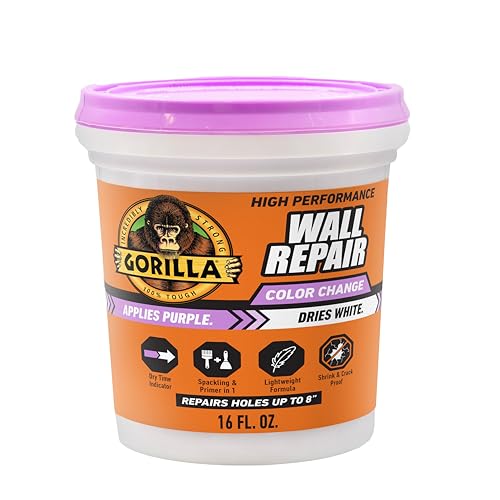
Best for a combined spackling and primer-like finish. This product applies purple and dries white, clearly signaling when sanding or painting can begin. It offers a lightweight, no-sag formula suitable for small to medium repairs. Choose this if you want a single-step repair that reduces the number of products needed. Caution: may not be ideal for very large repair zones where filler volume is substantial.
Buying Guide: How to Choose the Right Wall Repair Products
- Project size and depth: For shallow patches, lightweight or pink-to-white dry time indicators work quickly. For larger joints and seams, a standard joint compound or a patching plaster provides better bulk and strength.
- Drying time and dust: If minimizing dust is important, select low-dust or lightweight formulas. Color-change products help verify dryness without guesswork.
- Sanding and finishing: Some products dry ready-to-paint or even prime-in-one, reducing steps. Others may require priming depending on surface and paint type.
- Surface compatibility: Choose products tuned for plaster, drywall, wood, or masonry depending on the repair location to ensure adhesion and long-term stability.
- Ease of use: Ready-mixed, single-step patches save time on small jobs, while professional-grade joint compounds are better for large seams and trades.
FAQs
- What is the best product for small wall holes?
Answer: A ready-to-use patching plaster or a pink-to-white dry time spackling offers quick repair and fast sand/paint readiness. - Do color-changing spackles really indicate dryness?
Answer: Yes. Many products turn pink or purple on application and white when dry, signaling ready-to-work status. - Which product reduces dust during sanding?
Answer: Lightweight low-dust joint compounds are designed to minimize dust and shrinkage while maintaining a smooth finish. - Can I use these on textured walls?
Answer: Some products are designed for smooth finishes; for textured surfaces, a premium joint compound or patching plaster with proper skim and sanding is recommended. - Is a joint compound suitable for exterior work?
Answer: Most interior-focused compounds perform best indoors; use exterior-grade products or patching plaster specifically rated for outdoor use when repairing exterior walls.