Finding a reliable large protractor for woodworking can improve accuracy in bevels, miter cuts, and edge alignments. This guide highlights five high-visibility digital and traditional protractors ideal for carpentry, cabinet making, and shop projects. Each pick combines durable construction with easy-to-read displays and long measurement ranges to cover complex angles. Read on to compare features, readability, and ergonomic design that suit American workshops from hobby benches to professional shops.
| Product | Brand | Key Feature | Approximate Size |
|---|---|---|---|
| Digital Angle Finder Protractor (TBVHOMM) | TBVHOMM | 0–999.9° range, locking, upside-down read | 7 in / 200 mm |
| Neoteck 225° Digital Angle Finder | Neoteck | LCD backlight, 0–225° with 0.1° steps | 16 in / 400 mm |
| Digital Angle Finder Protractor (Rainyb) | Rainyb | 0–360°, full LCD, 0.05° resolution | 7 in / 180–360 mm |
| General Tools Angle Protractor #17 | General Tools | Stainless steel, 0–180°, 6″ adjustable arm | 6 in / 150 mm |
| BaBaYang Third Generation Protractor | BaBaYang | 0–999.9°, enhanced ABS, included batteries | 7.5 in / 220 mm |
TBVHOMM Digital Angle Finder Protractor
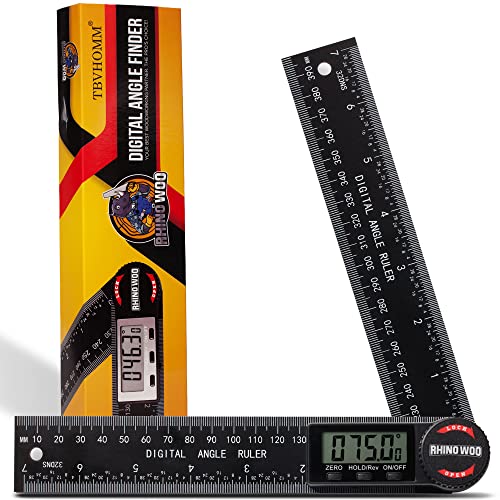
The TBVHOMM digital protractor combines a high-contrast ruler with a digital protractor, allowing quick measurements of lengths and internal or external angles. It features a locking knob to fix angles, a hold function for stable readings, and a reverse-read capability when measurements are large or inverted. The device includes a zero reset to rebase readings at any time, making it suitable for repeated tasks in woodworking, drafting, and construction. Reading clarity is enhanced by a large LCD display. Measurement range spans 0 to 999.9 degrees with ±0.3° accuracy and 0.1° resolution.
Neoteck 225° Digital Angle Finder

The Neoteck digital angle finder offers versatility as both a protractor and a level, making it ideal for woodworking projects such as trays, roof slopes, and handrails. It provides 0–225° measurements with 0.1° increments and an accuracy of ±0.5°. The LCD is backlit for visibility in dim environments, and a 5-minute auto-shutdown helps conserve batteries. This tool integrates horizontal and vertical checks into one compact device, essential for precise carpentry alignment and layout work.
Rainyb Digital Angle Finder Protractor
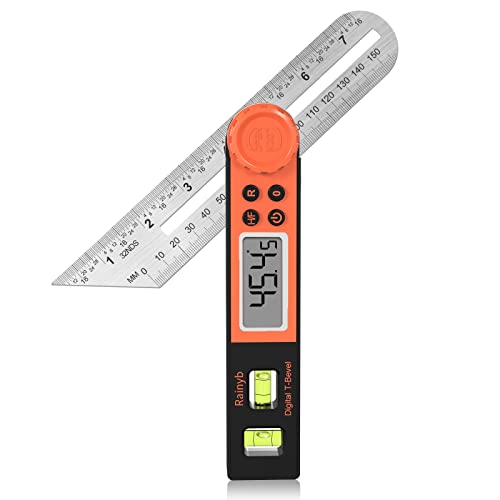
Rainyb’s digital angle finder provides a complete 0–360° range with a focus on precision and versatility. It records internal, external, and contraries angles with a resolution of 0.05° and an accuracy of ±0.5°. Features include a hold function to lock angles, power button, reverse angle read, and display flip for improved readings from any orientation. This tool is suitable for woodworking, metalworking, and general construction where full-circle measurement is required and precise angle transfer is needed.
General Tools Angle Protractor #17

General Tools offers a stainless steel protractor with a 6″ adjustable arm and a 0–180° semicircle scale. This design supports both left- and right-facing measurements and enables precise angle transfers. The rust-resistant steel construction and knurled thumb nut for locking enhance durability in shop settings. It’s a reliable staple for carpenters and hobbyists who value straightforward, robust angle measurement without electronics.
BaBaYang Third Generation Protractor

The Third Generation Protractor from BaBaYang combines a ruler and digital protractor with a millimeter and inch scale for easy inside and outside angle measurements. It uses durable Enhanced ABS construction and includes two CR2032 batteries. The tool offers a large LCD display and a measurement range of 0–999.9° with a stated accuracy of ±0.3° and a resolution of 0.1°. It is a versatile option for builders handling complex angle layouts in woodworking, carpentry, and metalworking alike.
Buying Guide: Key Purchase Considerations
- Measurement range and resolution: For large woodworking projects, prefer tools offering wide ranges (0–360° or more) with fine resolution (0.05–0.1°) to capture subtle angles.
- Display readability: A backlit LCD or high-contrast display improves visibility in dim shops. Consider upside-down read capability for overhead measurements.
- Locking and zeroing features: A solid locking mechanism and a reliable zero reset help ensure repeatable measurements and quick re-baselining during layout work.
- Durability and material: Stainless steel arms are robust for traditional protractors; enhanced ABS or metal construction can improve longevity in a busy workshop.
- Hybrid functionality: Digital protractors with T-bevel copying or sliding references simplify angle transfer, especially when duplicating complex joints or miters.
- Power and battery life: If choosing digital tools, check battery type, life, and auto-shutdown features to minimize downtime.
- Size and ergonomics: Large protractors are easier to read but heavier; balance size with comfort during frequent handling and transfers in woodworking tasks.
- Application scope: For cabinet making, trim work, and furniture assembly, digital models with horizontal/vertical bubble and 0–360° coverage provide maximum versatility.
In selecting a large protractor for woodworking, consider how often you’ll copy angles, the typical working environment, and whether you prefer digital convenience or traditional reliability. The options listed above cover a range of uses, from quick bevel checks to full-circle angle preservation, helping woodworkers maintain precision across a variety of projects.