Clear answers for buyers seeking coarse-to-medium sanding options. This guide highlights low-grit sandpapers and blocks suited for quick material removal, rough shaping, and prep work. Best for DIYers, woodworkers, furniture refinishing, auto body prep, and drywall finishing who want reliable, affordable options. The top picks prioritize durable backing, versatile grit ranges, and easy-to-use formats like blocks, sheets, and spongy sheets.
| Product | Best For | Grit Range Highlight |
|---|---|---|
| Romeda 8-Pack Sanding Block (60/80/120/220) | Coarse shaping and large-area prep | 60–80 coarse grits |
| 3M Aluminum Oxide Sandpaper (100/150/220) | General purpose sanding by hand or block | 100–220 mid to coarse |
| Sandpaper Assortment 120/220/400/600/800/1000/2000 (Shineboc) | Progressive finishing and polish | 120–2000 full range |
| Pukamam 24 Pcs Sanding Sponge (80–3000) | Wide range from coarse to ultra-fine in sponge form | 80–3000 diverse |
| TOVPADE 54PCS Micro Sander Kit (80–800) | Detail work and hard-to-reach areas | 80–800 inclusive |
Romeda 8-Pack Sanding Block (60/80/120/220)

Best for quick material removal and drywall or wood prep. These 3.9 x 2.76 x 0.6 inch sponge blocks offer four grit levels across two blocks per grit, including 60, 80, 120, and 220. The high-density sponge is flexible and tear-resistant, with each block designed to stay attached and provide consistent wear. Best for DIY projects that require interchangeable grit selection. Caution: sponges can wear unevenly if used aggressively on very hard surfaces without proper technique.
3M Aluminum Oxide Sandpaper (100/150/220)

Best for versatile hand or block sanding on paint, wood, and metal. The aluminum oxide sheets are suitable for hand use, sanding blocks, or cutting to size for power tools. The range includes 100, 150, and 220 grits, making it a practical starter set for routine prep tasks. Caution: fewer ultra-coarse options mean this set is oriented toward mid-range finishing rather than aggressive bulk removal.
Sandpaper Assortment 120/220/400/600/800/1000/2000 (Shineboc)

Best for a complete finishing progression from rough to ultra-fine. This kit includes seven grits (120/220/400/600/800/1000/2000) with three sheets per grit. It’s constructed from silicon carbide and electrostatically coated for even grit distribution and durability. Suitable for woodworking, automotive refinishing, and priming work. Caution: not ideal for extremely heavy material removal on hard metals, where larger grit ranges or blocks may be needed.
Pukamam 24 Pcs Sanding Sponge Set (80–3000)

Best for a broad range of projects with sponge blocks. The kit covers 80–3000 grit across multiple sponge blocks, including wet and dry use. This makes it well-suited for furniture refinishing, auto body prep, and delicate surface finishing. Caution: larger ultra-fine grits may require careful handling to avoid over-polishing soft woods.
TOVPADE 54PCS Micro Sander Kit (80–800)
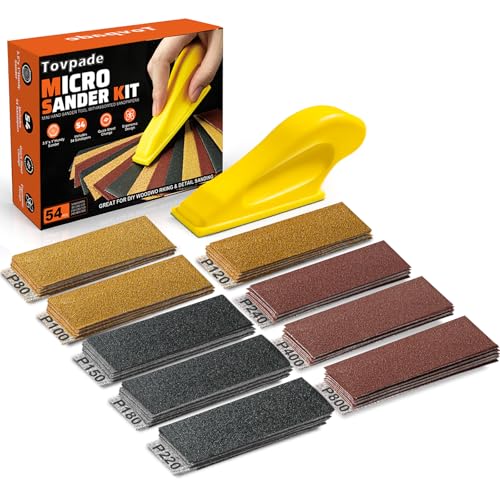
Best for detail work and hard-to-reach spaces. This kit includes a compact sanding block and 54 papers across 9 grit types (80/100/120/150/180/220/240/400/800). The three-color grit system helps users identify coarse, medium, and fine grits quickly. The hook-and-loop backing enables tool-free paper changes for uninterrupted sanding. Caution: the smallest block may not suit large flat surfaces; best used for precision work.
Buying Guide: Key Considerations For Low-Grit Sand Paper
- Grit range and project type: Choose 60–80 grits for aggressive material removal on wood, drywall, or metal. Pair with 120–220 grits for smoother finishes and primer prep.
- Form factor: Blocks and sponges offer control on flat and contoured surfaces. Sheets work well with power tools or hand sanding for larger areas.
- Material and durability: Aluminum oxide and silicon carbide provide durable, consistent abrasion. Expect longer life on synthetic surfaces and dry environments.
- Wet vs. dry use: Wet sanding reduces dust and can extend grit life; dry sanding is quicker for bulk material removal.
- Convenience features: Quick-change hooks, color-coded grits, and multi-grit assortments help minimize switching time and errors.
FAQ
- What grit should I start with for rough shaping? Use 60–80 grit for rough material removal on wood or drywall.
- Are sponge sanding blocks worth it for beginners? Yes, they provide flexible backing and better hand control for detailed or curved surfaces.
- Can I use wet and dry sandpaper on the same project? Yes, if the material and finish allow; wet sanding can reduce dust and improve finish quality.
- Which kit covers the widest grit range? The Shineboc assortment (120–2000) and Pukamam (80–3000) span broad ranges for progressive finishing.
- Is a finer grit necessary after roughing? Yes, proceed from coarse grits (60–80) to mid grits (120–220) and finish with ultra-fine grits (800–2000) for smoothness.
- Should I avoid any particular grit for metal work? Very coarse grits can scratch soft metals; use finer grits after initial shaping and consider wet sanding to minimize heat and dust.