Deck projects demand the right nail gun for speed, accuracy, and durable fasteners. This guide highlights five top decking nail guns across 21-degree framing models, 14-gauge T-nailers, and coil nailers, offering options for DIYers and professionals. Each tool brings a balance of weight, drive power, and nail compatibility to help you reach strong, long-lasting deck builds.
| Product | Brand | Type | Nail Range | Notes |
|---|---|---|---|---|
| NR90AES1 21° Framing Nailer | Metabo HPT | Framing Nailer (21°) | 2″ – 3-1/2″ | Lightweight, ~7.5 lbs; plastic collated nails |
| NR83A5 21° Framing Nailer | Metabo HPT | Framing Nailer (21°) | 2″ – 3-1/4″ | Selectable trigger; rafter hook; Pro Preferred |
| Freeman PCTN64 14-Gauge T Nailer | Freeman | T Nailer (14-Gauge) | 5/8″ – 2-1/2″ | Concrete & steel compatibility; durable construction |
| NV90AG(S) Coil Framing Nailer | Metabo HPT | Coil Framing Nailer (15°) | 1-3/4″ – 3-1/2″ | Cylinder valve drive; Pro Preferred award |
| SFR2190 21 Degree Framing Nailer | NuMax | Framing Nailer (21°) | 2″ – 3-1/2″ | Durable drive blade; compatible with 21° nails |
The following sections explore each option in detail, so you can compare performance, compatibility, and suitability for different decking tasks.
NR90AES1 21° Framing Nailer

Metabo HPT NR90AES1 is a 21-degree plastic-collated framing nailer designed for decking, flooring, and framing work. It supports applications including flooring and framing, truss build-up, window installation, subflooring, roof decking, wall sheathing, and general housing construction. Weighing about 7.5 pounds, it stays well balanced for maneuverability across joists and corners, reducing fatigue during long decking runs. The tool’s plastic-collated nails enable efficient rapid fastening, helping you finish large deck projects with consistent drive quality and durable results.
NR83A5 21° Framing Nailer

Metabo HPT NR83A5 combines fast response with versatility in a 21° framing nailer. It features a cylinder valve drive mechanism for quick, powerful driving and accepts 2″ to 3-1/4″ plastic collated nails. The selectable trigger mode lets you switch between contact or single-sequential actuation for different decking and framing tasks, while a rafter hook supports overhead work. Recognized as a Pro Preferred Nailer by Builder and Developer Magazine for multiple years, this tool is designed for reliable performance on longer deck builds and complex framing jobs.
Freeman PCTN64 14-Gauge T Nailer
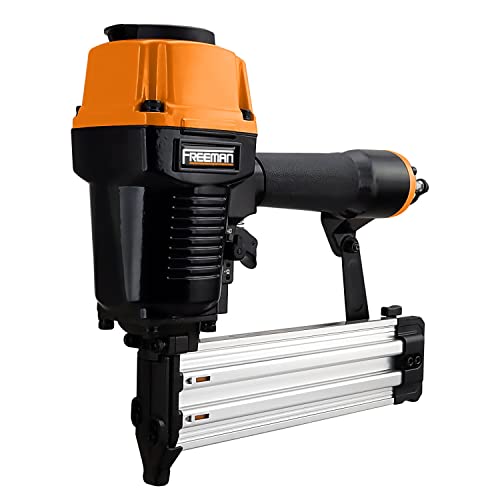
Freeman PCTN64 is a 14-Gauge T-nailer engineered for heavy-duty applications including concrete and steel projects alongside decking tasks. It drives 5/8″–2-1/2″ nails and is suitable for furring strips, plywood-to-concrete nailing, fencing, subflooring, siding, and soffits. The tool features a one-piece hardened steel drive blade and an anodized aluminum magazine and cylinder for long-term durability on challenging job sites. When working with composite decking or hard substrates, its T-nail capability provides secure, high-strength fastening for exterior builds.
NV90AG(S) Coil Framing Nailer

Metabo HPT NV90AG(S) is a 15° coil framing nailer built for floor, truss, and roof decking tasks. It accepts 1-3/4″ to 3-1/2″ coil nails, making it well suited for longer fasteners on larger decking runs. The cylinder valve drive mechanism provides fast response and powerful driving, while the tool’s Pro Preferred recognition underscores its reliability. A rafter hook and balanced design support overhead work, contributing to comfortable, efficient decking installation across multi-story or elevated projects.
SFR2190 21 Degree Framing Nailer

NuMax SFR2190 is a 21-degree framing nailer designed for framing, subfloors, roof decking, and related woodwork. It drives 2″–3-1/2″ plastic collated nails and uses a hardened steel drive blade for durability in demanding environments. This model is a practical option for projects requiring longer fasteners and reliable performance across deck framing and substructure tasks, with durability suitable for repeated use on multiple deck builds.
Buying Guide
Key Factors To Consider
- Nail angle and gauge: Decking tasks use a mix of 21° framing nails, 15° coil nails, and 14-gauge T-nails. Choose based on board type, joist spans, and desired holding power.
- Nail length and type: Longer nails are useful for thicker boards or over Joist setbacks; T-nails offer secure fastening on siding and concrete-adjacent work.
- Weight and balance: Lighter tools reduce fatigue for overhead decking and long runs along rails and stairs.
- Drive mechanism: Pneumatic actions (cylinder valve) provide speed and consistency; ensure your air compressor can sustain the tool’s demand.
- Safety features: Trigger options (selectable vs. continuous), safety guards, and anti-dry-fire protect both the user and material.
- Durability and warranty: Pro Preferred recognitions and solid build quality help with long-term performance on busy job sites.
Decking Use Cases
For deck framing, subflooring, and surface decking, 21° framing nails and 15° coil nails cover most installations. 14-Gauge T-nailers excel where nails need extra pull on hard substrates or when attaching structural elements to concrete or engineered boards. Staples are less common for decking but can be used for sheathing or thin sublayers where appropriate.
How To Choose Among The Five
Compare the five models by nail compatibility, weight, trigger type, and presence of features like rafter hooks or coil capability. If you plan long decking runs, a lighter tool with a reliable drive mechanism (such as the NR90AES1 or NV90AG(S)) can reduce fatigue. For concrete-adjacent installations, a 14-gauge T-nailer (Freeman PCTN64) provides solid fastening with compatible nails. Assess whether you need coil nails, T-nails, or traditional framing nails based on your deck design and substrate.
Practical Tips
- Use the correct fasteners for your deck boards and substructure to prevent loosening over time.
- Maintain consistent air pressure and lubrication, especially for extended decking sessions.
- Keep a spare supply of nails in compatible sizes to minimize downtime.
- Protect overhead work with a rafter hook where available.
- Wear safety gear and follow tool-specific safety instructions to prevent injuries.