Opaque yellow acrylic paints deliver strong coverage, bright hue, and reliable lightfastness for striking paintings. This guide highlights five top options across student lines and professional ranges, helping artists choose the right level of opacity, consistency, and drying time. It’s ideal for painters working on canvas, wood, ceramic, or mixed media. The selections focus on safe, non-toxic formulas for adults and kids alike, with clear notes on who benefits most from each product.
| Product | Best For | Notes |
|---|---|---|
| GOTIDEAL Acrylic Paint Mid Yellow | Beginner to intermediate artists | High pigment, non-toxic, quick-dry |
| Artecho Yellow Acrylic Paint | Travelers and students | Single pigment, good lightfastness |
| PEBEO Acrylic Fine Studio Opaque Yellow | School projects and large surfaces | Satin finish, easy to identify colors |
| GOLDEN Heavy Body Hansa Yellow Opaque | Professional artists needing coverage | Excellent opacity and lightfastness |
| GOLDEN Fluid Hansa Yellow Opaque | Fine brushwork and glazing | Versatile, semi-opaque, easy to tint |
Now let’s compare five opaque yellow acrylics, focusing on who benefits most, why they stand out, and potential limitations.
GOTIDEAL Acrylic Paint Mid Yellow

Best for: Beginners and families exploring acrylic painting. The large 120 ml tube provides plenty of material for canvas, wood, and crafts. The formula emphasizes non-toxicity and quick drying, making it suitable for classrooms and home studios.
Why chosen: The paint uses high-quality pigments designed to resist fading, with a user-friendly consistency that blends smoothly. It supports broad coverage and vibrant results on multiple surfaces.
Limitation: Some users may prefer higher viscosity for textural work; this line is designed for versatility rather than extreme texture.
Artecho Yellow Acrylic Paint
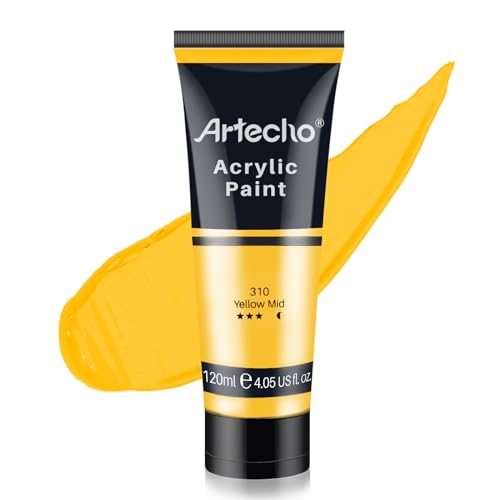
Best for: Travelers and students needing convenient, portable color options. The 120 ml tube keeps colors ready for on-site projects, while the single pigment approach supports flexible color mixing.
Why chosen: The paint offers lightfastness and a glossy finish when dry, with a creamy consistency that covers large areas and fine details alike. It’s compatible with canvas, wood, ceramic, and fabric applications.
Limitation: The gloss finish may differ from matte or satin finishes used in some projects; consider a final varnish if a uniform matte is desired.
PEBEO Acrylic Fine Studio Opaque Yellow

Best for: Students and professionals seeking affordable large-surface coverage with a studio finish. The satin finish provides a balanced sheen suitable for illustration and decorative painting.
Why chosen: The product line emphasizes ease of use, precise color identification, and consistent pigment quality. It blends well with other acrylics and is suitable for a variety of techniques.
Limitation: The cap design is focused on convenience; some artists may want a more secure dispensing system for travel or small studios.
GOLDEN Heavy Body Hansa Yellow Opaque

Best for: Professional artists seeking maximum opacity and strong color payoff. This heavy body paint maintains brush marks and textures, ideal for impasto and rich color blocks.
Why chosen: It offers excellent lightfastness and opacity, with a thick, brush-friendly texture that holds brushstrokes for expressive techniques. The PY74 pigment is a classic, reliable choice for vibrant yellows.
Limitation: Higher viscosity can require more effort to spread evenly; suitable thinners or mediums may be needed for smooth blends.
GOLDEN Fluid Hansa Yellow Opaque

Best for: Detailed work, glazing, and mixed-media painting where precise color control matters. The fluid formula provides smooth flow and excellent mixing potential.
Why chosen: Semi-opaque coverage with easy blending and compatibility with gels, mediums, and grounds makes it highly versatile for studio use and fine brushwork.
Limitation: Slightly more transparent than heavy body options; may require a second layer for full opaqueness on bold backgrounds.
Buying Guide: Key Considerations for Opaque Yellow Acrylics
- Opacity and pigment load: High-opacity yellows (like Hansa Yellow) provide strong coverage, while semi-opaque options are better for glazing and layering.
- Consistency and viscosity: Heavy body paints hold texture; fluids flow easily for details. Choose based on technique (impasto vs. smooth blends).
- Finish and lightfastness: Satin or matte finishes suit different looks. Check lightfastness ratings (ASTM D-4236 or similar) for durable color.
- Surface compatibility: Most acrylics work on canvas, wood, paper, and fabric. Consider surface prep and primer for best results on non-traditional surfaces.
- Safety and non-toxicity: AP, EN71, and similar certifications indicate kid- and classroom-friendly products. Ideal for families and educational settings.
- Mixing and compatibility: Most acrylics mix well with water, mediums, and gels. Test on a small area to ensure desired color shifts.
- Budget vs. pro-grade: Student-supply lines offer good coverage at lower cost; professional lines prioritize pigment concentration and permanence.
Frequently Asked Questions
- What makes a yellow acrylic paint “opaque”?: It uses pigments with strong coverage that minimize the visibility of underlying layers, resulting in solid color blocks.
- Is opaque yellow suitable for beginners? : Yes, especially options with smooth flow and non-toxic formulas, which are friendly for learning and experimentation.
- Can I mix opaque yellows with other colors? : Absolutely. Yellows blend well with blues, reds, and browns, enabling a wide range of greens and earthy tones.
- Which yellows are best for high-contrast work? : Hansa Yellow Opaque variants from GOLDEN are known for bright, consistent coverage ideal for bold accents.
- Should I buy both heavy body and fluid yellows? : Yes, use heavy body for texture and impasto, and fluid for smooth glazing and fine detail work.
- Are these paints safe for kids? : Several listed options are AP certified and EN71 or ASTM-compliant, suitable for adults and children under supervision.