Looking for a reflective additive to boost nighttime visibility of road markings, curbs, and parking areas? This guide highlights five top options that meet highway-grade standards and work with various paints and coatings. Best for contractors, property managers, and DIY enthusiasts who need high retroreflectivity, durability, and practical application guidance. Each product is chosen for clear why-it-wins reasons, with cautions when applicable, and a concise buying snapshot to compare at a glance.
| Product | Brand | Approx. Size | Best For |
|---|---|---|---|
| Reflective Glass Powder (1 LB Bag) | Marktiva | 1 lb | Small projects, quick testing |
| Reflective Glass Powder (10 LB Bag) | Marktiva | 10 lb | Medium to large areas, repeated use |
| Reflective Glass Powder for Traffic Paint & Epoxy | Roly Poly | 1 lb | Top-layer broadcast on wet paint |
| Reflective Glass Beads (1 LB Bag) | Roly Poly | 1 lb | Uniform microbeads for high retroreflectivity |
| Reflective Glass Powder (25 LB Bag) | Marktiva | 25 lb | Large-scale road markings |
Reflective Glass Powder 1 LB — Marktiva
Features: Reflective “Powder” Type 1 beads. These are the same reflective glass beads used on highway lines. Inter-mix or drop-on applications. Bead size: 100-200 US Mesh, Mil-Spec 10/11. This product is best for small projects, test patches, or when you want to experiment with texture before committing to larger batches. Best for contractors or DIYers who need ready-to-broadcast options and simple integration with water- or oil-based paints.
Best for: Small-scale markings, pilot tests, arts and crafts with road-themed elements. This option provides highway-grade bead quality in a compact package. Caution: Smaller bag means limited supply for large-area coverage; plan reapplication accordingly.
Reflective Glass Powder 10 LB — Marktiva

Features: AASHTO M-247 STANDARD DOT TYPE 1 highway beads. Sand-like texture. Inter-mix or drop-on applications. Bead size ranges 20-325 US Mesh, 45-850 microns. Refractive index >= 1.51. High quality and performance for top-coat use on paints, adhesives, epoxies, or industrial tape. Best for: Projects requiring higher volume and long-term nighttime visibility in road markings, parking lots, and curbs. Caution: Larger bead set may require compatible application equipment for uniform distribution.
Why selected: This size range and DOT Type 1 classification align with typical highway marking standards, making it suitable for professional-scale projects where retroreflectivity is critical.
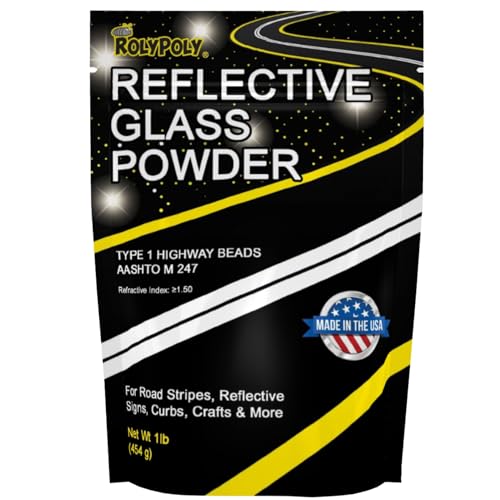
Reflective Glass Powder for Traffic Paint & Epoxy — Roly Poly
Features: MAXIMUM reflectivity when broadcast onto wet paint or epoxy coatings. Type 1 highway-grade beads suitable for parking lots, curbs, driveways, crosswalks, and industrial settings. Compatible with line striping equipment and bead dispensers. Best for: Professional striping crews and property managers needing bright nighttime markings immediately after application. Caution: Best results occur when broadcast onto fresh coatings; timing and technique influence reflectivity.
Reflective Glass Beads 1 LB — Roly Poly

Features: High-quality, uniform, round beads (95%+). Airport-quality glass beads with refractive index 1.5+. Increases nighttime visibility and durability. Best for: Bead-dense surfaces where maximum retroreflectivity is needed, especially in wet conditions. Caution: Larger beads can be less uniform if not dispersed properly; ensure even distribution to avoid hotspots.
Reflective Glass Powder 25 LB — Marktiva

Features: Made of tiny glass beads for reflective markings on roads, highways, curbs, concrete, parking lots, and airports. Applied to water-based paints, oil-based paints, alkyd coatings, hydrocarbon thermoplastics, methyl methacrylate, and epoxies. Best for: Large-scale projects requiring substantial material, such as long road corridors or multiple parking lots. Caution: Bulk handling requires storage planning and adequate mixing to ensure consistent dispersion.
Buying Guide
What should you consider when choosing a reflective additive?
- Application method: Broadcast-on-top vs. mixed-in. Broadcast-on-top generally yields maximum retroreflectivity with fresh coatings.
- Bead type and standard compliance: DOT Type 1 highway-grade beads meet highway marking expectations; ensure compatibility with your coating system.
- Mesh size and refractive index: Finer beads may spread more evenly in paint, while larger beads boost reflectivity in wet conditions; higher refractive index improves night visibility.
- Project scale: Small DIY projects suit 1 lb bags; larger contracts benefit from 10–25 lb bags for cost efficiency.
- Coating compatibility: Check whether the additive works with water-based paints, oil-based paints, epoxies, or other coatings you plan to use.
- Equipment compatibility: For professional line striping, verify that the product works with bead dispensers and line-striping machines.
Frequently Asked Questions
- What is the main difference between glass beads and glass powder?
– Glass beads are solid spheres that remain exposed to light, while glass powder is finer and can be broadcast into or onto coatings to create a reflective layer. - Can I mix reflective beads into paint?
– Some products are designed for mixing into coatings, but others are intended to be broadcast on top of wet paint for maximum brightness. - Is highway-grade (Type 1) reflective material necessary for my project?
– For formal road markings, Type 1 highway-grade beads meet common standards; smaller private lots may still benefit from similar retroreflectivity without formal certification. - Will reflective additives affect paint durability?
– When used as directed, these additives typically enhance visibility without compromising coating performance; follow manufacturer guidelines for best results. - How do I choose between 1 lb and 25 lb bags?
– Start with a small bag for testing; scale up to 25 lb for larger projects or ongoing maintenance depending on area coverage needs. - Are these additives safe for indoor use?
– Reflective beads designed for road markings are generally safe for indoor use on compatible coatings, but verify any ventilation or handling instructions on the product data sheet.