Answering the question “which walnut wood stain interior is best?” this guide highlights five top options that balance color depth, ease of use, and indoor suitability. The best picks span oil-based and water-based formulas, gel stains for vertical surfaces, and convenient built-in applicators. This selection targets homeowners refinishing furniture, cabinets, doors, and trim, as well as DIYers tackling small projects. Each product is evaluated for best-use scenarios, with clear notes on who should choose it and where to avoid common drawbacks.
Summary table of selected products
| Product | Best For | Notes |
|---|---|---|
| Varathane Premium Fast Dry Dark Walnut | Cabinets, furniture, doors | Oil-based; quick dry; one-coat coverage |
| Varathane Total Control Dark Walnut Gel | Vertical surfaces | Thick gel; low odor; water-based |
| SENVEN Walnut Wood Stain | Cabinets, furniture, indoor/outdoor | Water-based; low VOCs; non-toxic |
| Varathane Total Control American Walnut Gel | Indoor furniture and trim | Thick gel; fast-dry; low odor |
| Varathane Less Mess Dark Walnut | Small projects, touch-ups | Built-in applicator; easy cleanup |
Varathane Premium Dark Walnut Stain — Fast Dry, One Coat

Best for: interior projects where a deep, uniform color is needed with minimal coats. The oil-based formula is designed for furniture, cabinets, doors, trim, and paneling, offering one-coat coverage and a dry time of about one hour. Suitable for DIY refurbishments and professional projects that require a durable finish.
Why chosen: It provides robust color in a single application, which is advantageous for projects with time constraints. The ability to cover up to 70 square feet makes it a strong choice for medium-sized rooms or multiple items.
Caution: Oil-based stains can emit stronger fumes; ensure adequate ventilation and surface prep for best results. Clean-up requires appropriate mineral spirits or solvent-based cleaners.
Varathane Total Control Dark Walnut Gel Stain — Low Odor

Best for: vertical surfaces and indoor projects where splatter-control and precise application matter, such as banisters or cabinets. Gel formula is thick and no-drip, with a low-odor, water-based base.
Why chosen: The gel consistency reduces runs on vertical areas and simplifies application on complex surfaces. Quick-dry time facilitates faster project completion.
Caution: Gel stains can require more effort to achieve uniform color on very porous woods; shake well and apply evenly to prevent patchiness.
SENVEN Walnut Wood Stain — Non-Toxic, Water-Based

Best for: households prioritizing low VOCs and a natural matte finish, ideal for kitchen cabinets, furniture, and indoor wood projects. The product emphasizes non-toxic, water-based formulation with quick drying and deep color penetration.
Why chosen: This option strikes a balance between color depth and environmental considerations, making it suitable for spaces with kids or pets. It enhances natural grain while keeping fumes minimal.
Caution: Surface prep and good shaking are recommended to ensure even color distribution across the wood grain.
Varathane Less Mess Dark Walnut With Built-In Applicator
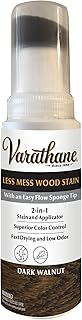
Best for: small projects, touch-ups, and crafts where a built-in applicator simplifies the process. The 4-ounce size suits quick refinishing tasks on furniture or trim.
Why chosen: The integrated applicator reduces setup and cleanup time, making it convenient for beginners and hobbyists. The product helps control color with an easy flow sponge tip.
Caution: The smaller container may require multiple coats for deeper color on very dense woods; plan for additional coats if the target shade isn’t reached in one pass.
Buying Guide: Walnut Wood Stain Interior — Key Considerations
- Finish Type: Oil-based stains typically yield richer color and longer durability but require solvent cleanup and ventilation. Water-based stains are lower odor and easier to clean, though color depth may vary by wood type.
- Gel vs. Liquid: Gel stains are ideal for vertical surfaces and controlled application; liquid stains work well for broad, flat surfaces but may run if not prepped properly.
- Surface Type: For cabinets and trim, prioritize products with fast-dry times and good adhesion to oak, pine, maple, or other common interior woods. For furniture, color uniformity and grain enhancement are key considerations.
- VOC and Safety: If indoor air quality matters, choose low-VOC or non-toxic formulas and ensure proper ventilation during application and curing.
- Application Tools: Built-in applicators simplify small projects. For larger projects, consider brushes or rags suited to oil- or water-based formulas.
- Finish Longevity: Consider topcoats (polyurethane, lacquer) compatible with the stain to protect the color over time, especially in high-traffic areas.
Frequently Asked Questions
- What’s the difference between oil-based and water-based walnut stains?
Oil-based stains typically provide richer color and deeper penetration, but require mineral spirits for cleanup and more ventilation. Water-based stains dry faster, have lower odor, and are easier to clean up with soap and water. - Is gel stain better for cabinets or furniture?
Gel stain is often better for cabinets and vertical surfaces because it resists dripping and provides more control over application, reducing mess on large flat areas. - Can I apply walnut stain over an existing finish?
Yes, but you should sand or degloss the surface first to ensure good adhesion and an even finish. Always test a small area first. - How many coats are typically needed for a rich walnut color?
It depends on the wood and product. Some stains offer buildable color with multiple light coats, while others claim one-coat coverage. Always follow the manufacturer’s recommendations and test on a scrap piece. - Will walnut stain darken unevenly on blotchy woods?
Wood with uneven pores or resin can appear blotchy; preconditioning or using stains with more even penetration can help achieve uniform color. - Should I seal the stained wood with a finish?
Yes. A compatible topcoat such as polyurethane or shellac helps protect the color and durability, especially for high-use furniture or kitchen cabinets.